At a glance
| Where | Starts at the Národní 17 memorial (Nové Město), ends at Letná Park (Holešovice) |
| Cost | Free — every stop on this walk is an outdoor site or public memorial |
| Time needed | Around 2.5–3 hours |
| Getting there | Metro Národní třída (line B) to start; tram from Čechův most back to the centre at the end |
| Best time | Year-round; 17 November (a Czech public holiday) is the most meaningful date to walk it |
Forty-one days that ended forty-one years
The Velvet Revolution of November 1989 is one of the great peaceful revolutions in modern history. It began with a sanctioned student march on 17 November (commemorating the 50th anniversary of Nazi suppression of Czech universities) that turned into a large political demonstration, then into a riot when police attacked the marchers with batons on Národní Street. The brutality of the response — televised, undeniable — galvanised the population.
Over the following weeks, Prague’s Wenceslas Square filled with hundreds of thousands of people nightly. Civic Forum, the opposition coalition led by dissident playwright Václav Havel, negotiated from the Laterna Magika theatre. The Communist Party resigned from power. By 29 December, Václav Havel had been elected president by the Federal Assembly — the parliament he had never been allowed to address. The transition was so disciplined and nonviolent that Western observers called it “velvet.”
This walk traces the physical geography of those weeks. The sites are marked, some with memorials, some with plaques, some with nothing but their continued existence as places where history happened.
The walk, stop by stop
Stop 1: Národní 17 memorial
Národní 16 (passage), Nové Město | Metro: Národní třída (line B)
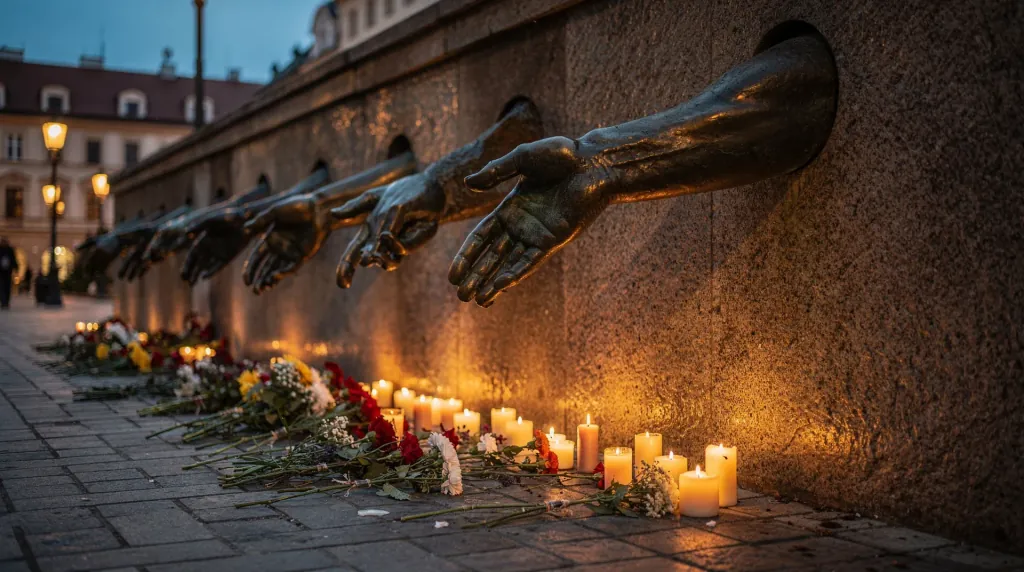
Begin at the passage at Národní 16, where the memorial to 17 November 1989 is embedded in the wall. A row of bronze reliefs — hands reaching outward from the stone — marks the spot where police attacked the student demonstration. The march had been officially sanctioned; the police response was not. The images of students sitting down with raised hands being beaten went around the world.
The memorial is understated and quietly powerful. Many Praguers leave flowers. The passage itself is unremarkable — it is exactly the type of ordinary urban space where history happens: a covered entrance to an apartment building, not a monument.
Allow 10 minutes.
Stop 2: Wenceslas Square — the demonstration site
Václavské náměstí | Metro: Muzeum (lines A+C)
Walk from Národní to Wenceslas Square — the central boulevard that was the stage for the revolution’s mass acts. Between 19 November and 27 November 1989, hundreds of thousands of people gathered here nightly — estimates range from 200,000 to 800,000 at the peak. The Jan Palach memorial near the National Museum (upper end of the square) is the fixed point: people stood here with candles and clashed keys, a distinctive sonic protest — the sound of keys being rattled was the signal of unlocking, of opening.
The square is 750 metres long; walking it from the lower end (Můstek) to the upper end (National Museum) gives the physical sense of its scale and the density of the crowds it held.
Allow 20 minutes.
Stop 3: Melantrich Building balcony
Václavské náměstí 36, Nové Město | Wenceslas Square
On 22 November 1989, Václav Havel and Alexander Dubček (the leader of the 1968 Prague Spring, rehabilitated for the occasion) appeared together on the balcony of the Melantrich Building — then occupied by the socialist press — to address the crowd below. The combination of Havel and Dubček on the same balcony, speaking to half a million people, was the moment at which the revolution’s success became visible even to those who had doubted it.
The building is now an H&M store. The balcony is visible from the square. A plaque marks the significance of the address.
Allow 5 minutes.
Stop 4: Laterna Magika — Civic Forum headquarters
Národní 4, Nové Město | Adjacent to the National Theatre | Metro: Národní třída (line B)
The Laterna Magika (Magic Lantern) theatre was commandeered by Civic Forum as its operational headquarters during November 1989. Havel ran the negotiations with the Communist government from the backstage rooms of the theatre while performances continued on the stage above. The combination of theatrical tradition and political revolutionary activity in the same building — Havel was a playwright; Laterna Magika was Prague’s experimental theatre — was entirely appropriate.
The theatre is now part of the National Theatre complex and continues to operate. The exterior is plain; enter for the theatrical programme if available. A small exhibition in the lobby documents the 1989 period.
Allow 10–15 minutes.
Stop 5: Czech Radio building
Vinohradská 12, Vinohrady | Metro: Náměstí Míru (line A)
A short walk or one metro stop east to the Czech Radio building on Vinohradská. In 1968, this was where Czechoslovak Radio broadcast independent news as the Soviet tanks entered Prague — the broadcasters kept going until the building was physically occupied. In 1989, Czech Radio was one of the first institutions to begin broadcasting news that contradicted the official Communist account of 17 November. A plaque and memorial panel outside the building document both events.
Allow 10 minutes.
Stop 6: Letná Park — the rally site and the empty plinth
Letenská pláň, Holešovice | Tram: Čechův most
The walk ends at Letná Park, where on 25 November 1989 the largest single demonstration of the Velvet Revolution took place: approximately 750,000 people gathered on the Letná Plain to hear Havel and opposition speakers. The grassy plain can hold this number — barely. The sheer scale of the 25 November rally, larger than any previous gathering in Czech history, made the Communist government’s position untenable within days.
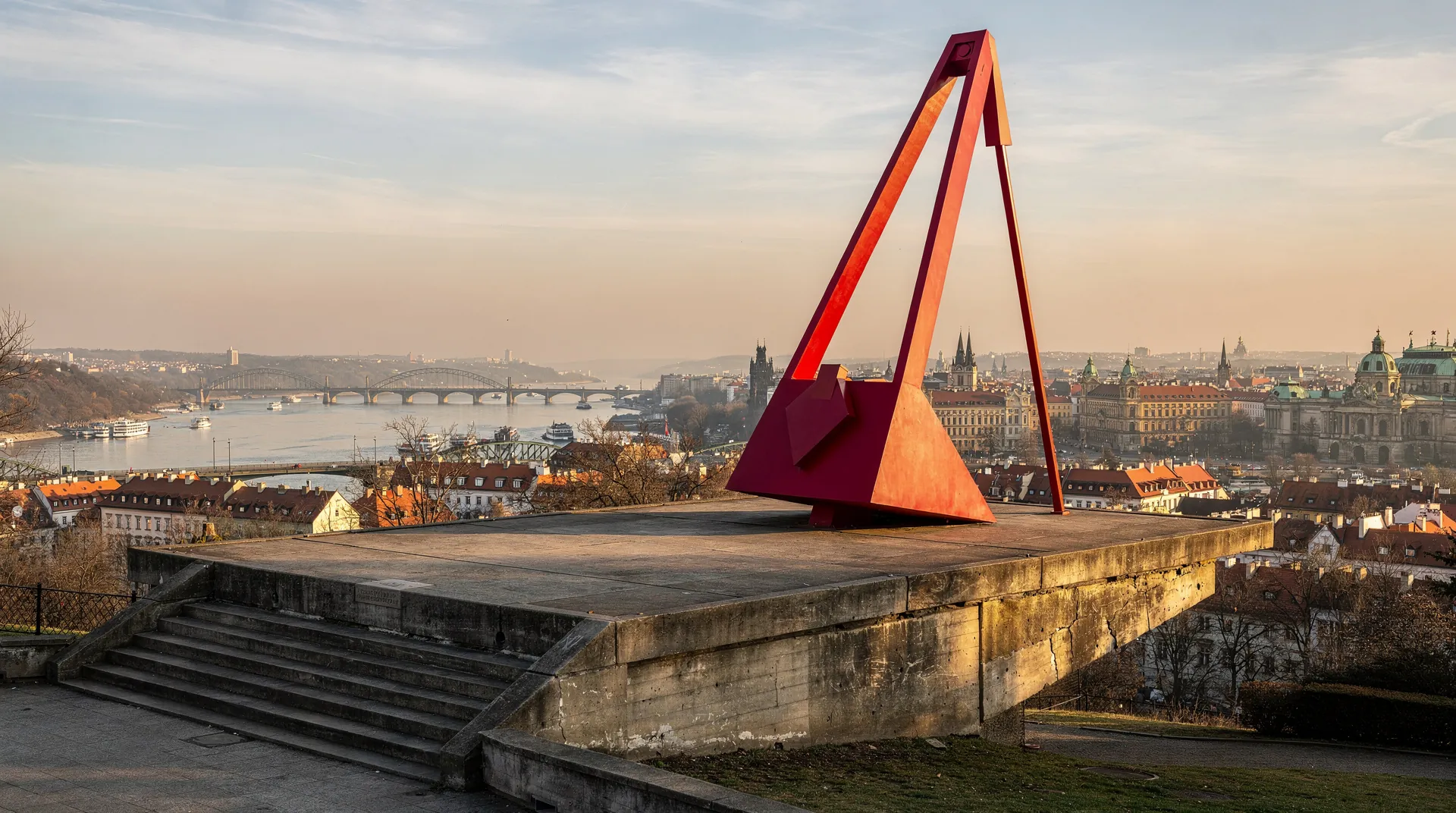
The famous empty plinth (where Stalin’s statue stood until 1962) overlooks the rally site; the David Černý metronome ticks above it. From the park terrace, the view of Prague Castle and the city below provides the geographic context for everything you have walked.
Allow 20 minutes.
Fit for more
The Museum of Communism (Na Příkopě 10) covers the full 41-year context for the 41-day revolution. The Communist-era Prague walk covers the same geography with a different emphasis. Together, the two walks form a complete picture of Prague under and after Communism.
A day-by-day sense of the 41 days
This walk covers the physical sites, but the timeline itself helps make sense of why each stop matters:
| Date | Event | Site on this walk |
|---|---|---|
| 17 Nov 1989 | Police attack student march | Národní 17 memorial (Stop 1) |
| 19–27 Nov | Nightly mass demonstrations, up to 800,000 people | Wenceslas Square (Stop 2) |
| 22 Nov | Havel and Dubček address the crowd together | Melantrich Building balcony (Stop 3) |
| Nov–Dec | Civic Forum negotiates with the government | Laterna Magika (Stop 4) |
| 25 Nov | Largest single rally, ~750,000 people | Letná Park (Stop 6) |
| 29 Dec | Havel elected president | (Federal Assembly, not on this walk) |
Walking the route in this order roughly follows the chronology, which is part of why it works better as a single sequence than as scattered individual stops.
Pairing this walk with Prague’s other history walks
This trail sits well alongside the Communist-era Prague walk (the 41-year context before 1989) and the day trip to Terezín (the WWII-era context that preceded Communism). Together they cover roughly a century of 20th-century Czech history across three separate outings — doing all three on one trip is ambitious but gives real depth for anyone with a serious interest in modern Czech history. If you only have time for one, this walk is the most emotionally direct: every site is either a memorial or a place where an identifiable historic moment happened, rather than a museum explaining events that happened elsewhere.
Practical info
- Start: Národní 17 memorial, Národní 16, Metro: Národní třída (line B)
- End: Letná Park, tram back to centre: Čechův most (lines 1, 8, 25, 26)
- Duration: 2.5–3 hours
- Distance: approximately 5 km (3 miles)
- Indoor vs outdoor: primarily outdoor; Laterna Magika lobby (brief indoor stop)
- Season: 17 November is Struggle for Freedom and Democracy Day — a public holiday in the Czech Republic; the Národní 17 memorial and Wenceslas Square are particularly significant on that date
- Accessibility: flat route through the city centre; Letná involves a short uphill path from the tram stop
Questions about the Velvet Revolution
Who was Václav Havel?
Václav Havel (1936–2011) was a Czech playwright, dissident, and statesman. He was the leading voice of Civic Forum during the 1989 revolution and became the first post-Communist president of Czechoslovakia, serving until 1992, and then as the first president of the Czech Republic from 1993 to 2003. He is regarded internationally as one of the great moral political figures of the 20th century.
Why was it called the Velvet Revolution?
The name comes from the completely non-violent nature of the transition — no shots were fired, no political prisoners were executed. “Velvet” implies smooth, unbroken, without tearing. It was coined by Western journalists and adopted by Havel himself.
What happened on 17 November 1989?
A student march from Albertov (a university district) to Vyšehrad, and then toward Wenceslas Square, was stopped on Národní Street by riot police. Police attacked the demonstrators with batons. One unconfirmed report (later disputed) claimed a student had been killed; the report — whether accurate or not — mobilised the population overnight. Photographs and footage of the police attack circulated rapidly.
Was the revolution entirely peaceful?
Yes. The 17 November police attack injured dozens of students but killed no one. Subsequent demonstrations were unimpeded. The Communist Party leadership negotiated with Civic Forum rather than ordering a military response — a decision shaped partly by the awareness that neighbouring Communist regimes (East Germany, Hungary, Poland) had already fallen or were falling.
What happened to Czechoslovakia after 1989?
After the Velvet Revolution, Czechoslovakia held free elections in June 1990. It then separated peacefully into the Czech Republic and Slovakia on 1 January 1993 — the Velvet Divorce, a name consciously echoing the Velvet Revolution. Both countries joined the European Union in 2004.
Is this walk suitable for children or a general-interest visitor?
Yes for older children and teenagers, especially with some context given beforehand — the memorial at Národní 17 is understated rather than graphic, and Wenceslas Square and Letná Park are simply open public spaces today. For a general-interest visitor without particular history interest, the walk still works as an easy, free, mostly outdoor route through central Prague with a strong narrative thread; it doesn’t require deep prior knowledge of Czech history to follow.
Go deeper
Prague: World War II and Communist history tour — guided walk covering the WWII and Communist context that led to the 1989 revolution.
Prague: Communism history and nuclear bunker guided tour — extends the Communist-era context with access to an actual Cold War bunker.