At a glance
| Where | Starts at Villa Amerika (Nové Město), ends at Vyšehrad Cemetery |
| Cost | Museum around €5 / CZK 125; basilica around €3 / CZK 75; walk itself is free |
| Time needed | Around 3 hours, 4 with an evening concert at the Rudolfinum |
| Getting there | Metro I.P. Pavlova (line C) to start; Metro Vyšehrad (line C) at the end |
| Best time | Year-round; autumn and spring suit Vyšehrad best; check the Czech Philharmonic programme in advance if you want to end with a concert |
The composer who defined Czech music to the world
Antonín Dvořák (1841–1904) is the composer who made Czech music internationally legible. Bedřich Smetana created Czech national opera; Dvořák took the Czech melodic tradition and its Slavic folk elements into the concert hall in a form that Western Europe and America could hear and love. The New World Symphony (1893), written during his three years as director of the National Conservatory of Music in New York, introduced Bohemian and Native American melodic material to a global audience. It remains one of the most performed symphonies in the world.
But Dvořák’s story is essentially Prague’s story. He was born in Nelahozeves, a village on the Vltava north of the city. He spent his working life in Prague, teaching at the Conservatory, conducting at the Rudolfinum, living in the neighbourhood of Žitná Street. He is buried at Vyšehrad, the ancient fortress above the Vltava that is the mythological origin point of the Czech nation. His grave is among those of Smetana, Mucha, and other Czech cultural figures in the Slavín mausoleum — a collective monument to Czech achievement.
This walk traces that geography: from his museum to the Rudolfinum, the venue most associated with his public career, to Vyšehrad, where he rests.
The walk, stop by stop
Stop 1: Dvořák Museum — Villa Amerika
Ke Karlovu 20, Nové Město | Metro: I.P. Pavlova (line C)
The Dvořák Museum occupies Villa Amerika, a Baroque summer palace built in 1720 by Kilián Ignaz Dientzenhofer. Dvořák lived nearby; the museum in his honour opened here in 1932. The permanent collection includes original manuscripts (the cello concerto, the Slavonic Dances, letters from Brahms), his piano, photographs, and personal effects. The summer garden concerts held here are a particularly pleasant experience — chamber music in an 18th-century garden.
Admission: €5 (CZK 125). Allow 45 minutes.
Stop 2: National Theatre — Národní divadlo
Národní 2, Nové Město | Metro: Národní třída (line B)
Walk west toward the river to the National Theatre. Dvořák’s opera Rusalka premiered here in 1901 — one of the most frequently performed Czech operas, with the soprano aria “Song to the Moon” (Měsíčku na nebi hlubokém) beloved internationally. The National Theatre building itself (opened 1883, rebuilt after a fire) was a collective national project that Dvořák supported; the building’s foundation-laying ceremony in 1868 drew the entire Czech cultural establishment.
The National Theatre hosts Czech opera regularly; if Rusalka is in the current programme, it is one of the most rewarding possible evenings in Prague.
Allow 10 minutes exterior; longer if attending a performance.
Stop 3: Rudolfinum — Dvořák Hall
Náměstí Jana Palacha 1, Josefov | Metro: Staroměstská (line A)
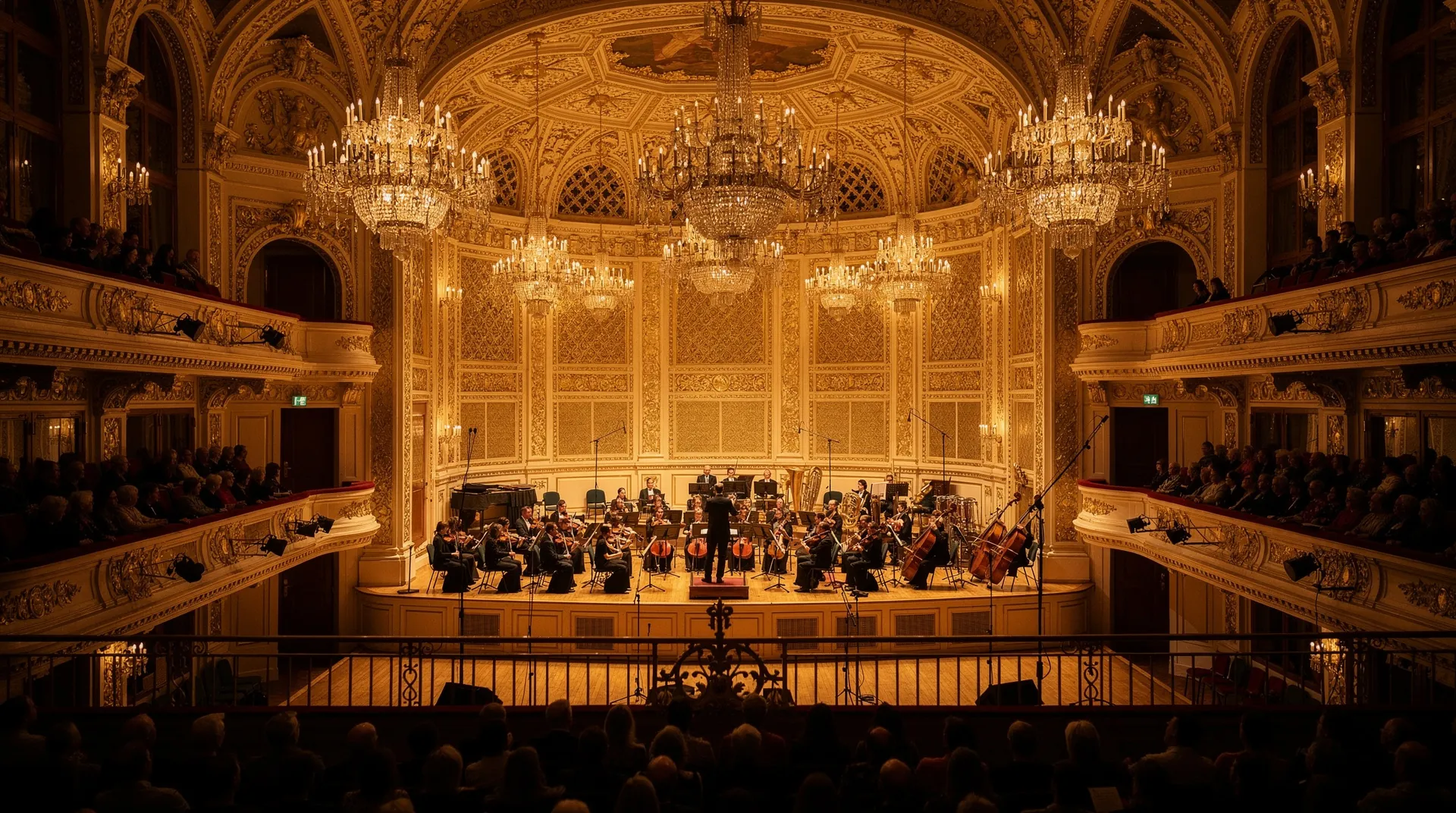
The Rudolfinum is the centre of this walk’s emotional geography. Dvořák served as artistic director of the Czech Philharmonic’s predecessor ensemble here from 1896 to 1901 — the last five years of his active conducting career. The neo-Renaissance building, opened in 1885 and named after Crown Prince Rudolf, was built specifically as a concert and exhibition hall and represents the highest ambitions of the Czech national cultural revival.
The Dvořák Hall (the main concert hall, 1,200 seats) is among the finest acoustic spaces in Europe. The Czech Philharmonic performs here year-round; any concert in the main hall is a direct connection to the tradition Dvořák helped establish.
Allow 20 minutes exterior; attending a concert is the full experience.
Stop 4: Czech Conservatory of Music
Nám. Jana Palacha 25, Josefov | Adjacent to the Rudolfinum
The Czech Conservatory of Music stands beside the Rudolfinum on the same square. Dvořák taught composition here from 1891 to 1895 before his New York period and again from 1895 to his death in 1904. His students included Josef Suk (his son-in-law) and other major Czech composers of the early 20th century. The building is in active use; no public museum access, but the exterior and the square’s atmosphere are part of the Dvořák geography.
Allow 5 minutes.
Stop 5: Vltava River — the view from Čechův most
Čechův most (Čech Bridge) | Walking distance from the Rudolfinum
Walk to the bridge and pause. Dvořák lived on Žitná Street (10 minutes south) and walked this embankment regularly. The view from Čech Bridge encompasses the castle, the Lesser Town, the river curve, and the hills beyond — a landscape that appears in his music in the sense that Smetana explicitly used it (Má vlast’s second movement depicts the Vltava from its Šumava springs to Prague and beyond). Standing here with any Dvořák symphony in mind creates the appropriate orientation.
Allow 10 minutes.
Stop 6: Vyšehrad Cemetery — Slavín mausoleum
V Pevnosti 159, Vyšehrad | Metro: Vyšehrad (line C)
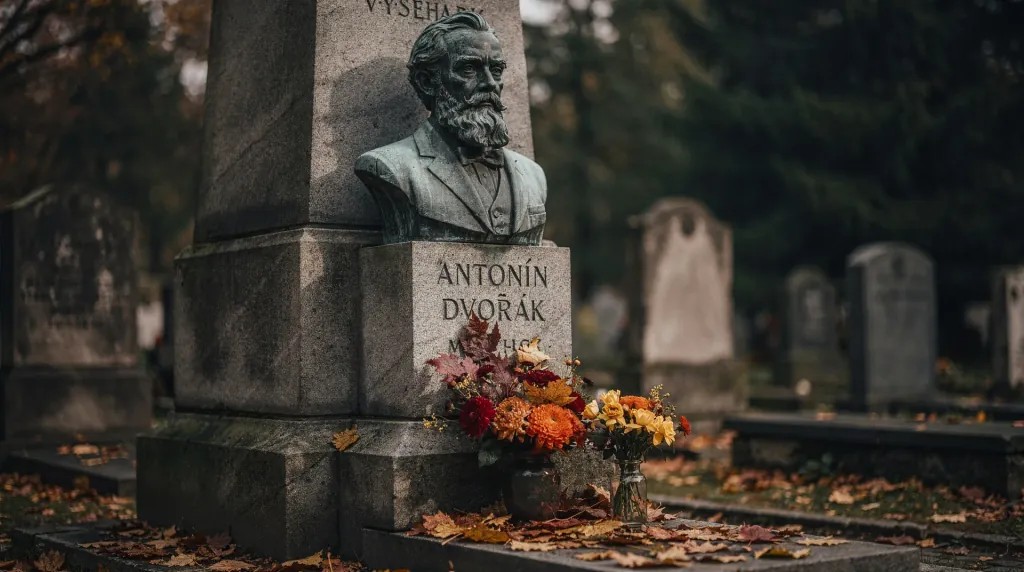
The walk ends at Vyšehrad, the ancient fortified plateau above the Vltava south of the city centre. The Vyšehrad Cemetery, adjacent to the Basilica of St. Peter and Paul, contains the Slavín mausoleum — a collective tomb erected in 1893 to honour Czech cultural and artistic figures. Dvořák is buried here (grave L-5), as are Bedřich Smetana (grave L-1), Alfons Mucha, and Karel Čapek. The cemetery is maintained in excellent condition; graves are individually planted and tended.
The Vyšehrad fortress itself — the rocky promontory with views down the Vltava to Prague Castle — is a pleasure in itself. The history of Vyšehrad (the legendary seat of the first Přemyslid princes; the subject of Smetana’s Má vlast opening movement) adds a deeper resonance to a visit.
Cemetery admission: free. Open daily 8am–8pm (summer), 8am–6pm (winter). Basilica admission: €3 (CZK 75).
Allow 30–45 minutes.
Choosing a concert venue to end the walk
If you want to close the day with live music, Prague has several venues associated with Dvořák and his contemporaries — they are not interchangeable, and picking the right one changes the experience:
| Venue | Association | Programme | Best for |
|---|---|---|---|
| Rudolfinum (Dvořák Hall) | Dvořák conducted here 1896–1901 | Czech Philharmonic, symphonic programme | Completing this walk’s arc |
| National Theatre | Rusalka premiered here in 1901 | Opera and ballet | Rusalka or other Czech opera specifically |
| Municipal House, Smetana Hall | Named for Dvořák’s contemporary Smetana | Symphonic and chamber concerts | Comparing Dvořák to Smetana’s tradition |
Booking ahead matters here more than at most Prague sights — the Czech Philharmonic season sells out well in advance for popular programmes, and the Rudolfinum’s acoustics are worth planning around rather than leaving to a walk-up ticket.
Beyond Dvořák: the wider Czech musical geography
Dvořák did not work in isolation. His teaching in Josefov sat alongside Smetana’s earlier national-opera project, and the Vyšehrad fortress that holds his grave is the same site Smetana’s Má vlast opens with musically — the two composers’ legacies are physically interwoven at the Slavín mausoleum.
Anyone who enjoys this walk and wants a broader Czech cultural itinerary should also look at classical concerts around the city and the Mucha trail, which covers the visual-arts equivalent of this musical pilgrimage from the same national-revival period. The Velvet Revolution sites walk, by contrast, picks up the 20th-century political history that the earlier composers’ generation did not live to see.
Practical info
- Start: Dvořák Museum, Ke Karlovu 20, Metro: I.P. Pavlova (line C)
- End: Vyšehrad Cemetery, V Pevnosti 159, Metro: Vyšehrad (line C)
- Duration: 3 hours self-guided; 4 hours if attending an evening concert at the Rudolfinum
- Distance: approximately 5 km (3 miles)
- Indoor vs outdoor: Dvořák Museum and Rudolfinum (if attending a concert) are indoor; all other stops are outdoor
- Season: excellent year-round; Vyšehrad is particularly beautiful in autumn (October) and spring (April–May)
- Accessibility: the Vyšehrad metro exit is at the fortress level — fully accessible; the cemetery is flat; the Dvořák Museum garden is gravel
Questions about Dvořák and Prague
What is the New World Symphony?
Dvořák’s Symphony No. 9 “From the New World” was written in New York in 1893 during his three years as director of the National Conservatory of Music. He incorporated melodic ideas from African American and Native American traditions he heard in America, combined with his Bohemian melodic instincts. The second movement Largo, with its famous cor anglais melody, is among the most recognisable passages in classical music.
How is Dvořák’s name pronounced?
DVOH-zhak (approximately). The hacek (háček) above the r makes it a retroflex consonant — approximately “rzh”. Praguers are understanding of foreign approximations but appreciate the effort.
Was Dvořák friends with Brahms?
Yes. Brahms was on the jury of the Austrian State Stipendium that awarded Dvořák a significant grant in the 1870s and became an advocate for his music. They corresponded for 20 years; Brahms arranged for Dvořák’s Slavonic Dances to be published by his own publisher Simrock. The friendship was productive and genuine.
Can I see original Dvořák manuscripts in Prague?
Yes. The Dvořák Museum has original manuscripts on display. The National Museum also holds Czech musical heritage materials. The Museum of Czech Music (Karmelitská 2, Malá Strana) has broader Czech musical heritage, including Dvořák.
Where did Dvořák die?
At his Prague home on Žitná Street on 1 May 1904. He collapsed at lunch; the cause was likely stroke combined with kidney disease. He was 62. His funeral drew enormous crowds; a state funeral was held at the Týn Church on Old Town Square.
Is the Dvořák Trail suitable if I don’t know classical music well?
Yes, though it rewards a small amount of preparation — listening to the New World Symphony or Rusalka’s “Song to the Moon” beforehand turns the Rudolfinum and National Theatre stops from generic exteriors into something specific. It pairs comfortably with a broader first day of classical concerts if you want to build context before committing to a full evening performance.
Can I combine the Dvořák Trail with other Prague walks in one day?
It is possible but tight. The Mucha trail shares some of the same national-revival geography and can be combined with a lighter version of this walk in a single long day; adding Velvet Revolution sites as well is usually too much for one day given the different neighbourhoods involved.
Go deeper
Prague: classical music concert at Rudolfinum — attend a concert in the hall where Dvořák conducted, the natural conclusion to this walk.
Prague: classical concerts at Smetana Hall, Municipal House — the complementary Smetana concert venue, named for Dvořák’s contemporary and rival for Czech musical supremacy.