At a glance
| Where | Evropská / Divoká Šárka, Praha 6 — Vokovice, in Dejvice |
| Cost | Reserve free; Džbán beach around €4 / 100 CZK in peak season |
| Time needed | 45–60 minutes for the valley floor; 2–2.5 hours for the full 7–8 km loop |
| Getting there | Tram 20 or 26 to the Divoká Šárka terminus, around 25 minutes from the centre |
| Best time | Weekday mornings in May–June or September for wildflowers/colour without the weekend crowds |
Prague’s largest nature reserve — and its legend
The name Šárka comes from one of the oldest stories in Bohemian literature. Cosmas of Prague, writing his Chronica Boemorum in the early 12th century, recorded the legend of the maiden war fought between Czech men and a group of warrior women led by Vlasta following the death of the princess Libuše. Šárka was one of Vlasta’s lieutenants — she lured the warrior Ctirad into the valley by chaining herself to a tree and crying for help. When he freed her, she blew a horn that summoned the warrior women from the hills; Ctirad and his men were captured and killed. The valley has carried her name ever since.
Whether the legend has any historical root is debated. What is not debated is that the valley is exactly the kind of place a story like that could be set: narrow, rocky, wooded, with steep slopes rising on either side of the Šárecký potok stream. The topography makes the name feel apt even without the mythology.
Divoká Šárka was designated a protected natural area in 1964. It covers approximately 10 km² in the northwestern part of Prague 6, bordering the districts of Vokovice and Liboc. The reserve is managed by the Prague city administration and is one of the few places in the city where the landscape has been left essentially intact — no manicured lawns, no fountains, no ornamental planting. The vegetation is mixed deciduous forest on the upper slopes, open meadows in the valley floor, and exposed rocky outcrops that run along the canyon walls.
The landscape — rocky valley, stream, meadows
The defining feature of Divoká Šárka is the canyon carved by the Šárecký potok. The stream drops through the reserve from west to east, eventually emerging at Podbaba where it joins the Vltava. In the upper section of the reserve, the valley is narrow and the sides steep; the rock faces are rhyolite and tuff, volcanic in origin, and the cliff profiles are notable enough that geologists have named one formation the Šárecký profil — a cross-section through different geological strata visible in the canyon wall.
The stream is small — shallow enough to wade across at many points — but it structures the entire reserve. Trails on both the north and south banks follow its course, crossing back and forth on footbridges. The meadows on the valley floor flood in early spring and are at their most impressive in May, when the grass is long and the wildflower density is high. Yellow cowslips and common orchids appear in the wet meadow sections; the south-facing rocky slopes carry thyme and other dry-habitat species.
The forested upper slopes are quieter than the valley. Beech and oak dominate, with sections of old hornbeam. The forest floor in spring carries wood anemones and ramsons — the wild garlic smell is noticeable on the upper paths in April. In summer the canopy closes and the upper trails are cool even in full sun.
Higher still, past the tree line on the ridge, the landscape opens out into scrubby grassland with views across northwestern Prague. The contrast with the enclosed valley below is significant — you move from a landscape that feels deeply rural to one that clearly belongs to a city, with Dejvice’s apartment blocks visible in the middle distance.
How to get there — tram, metro, on foot
By tram (recommended): Trams 20 and 26 run from the city center to their terminus at Divoká Šárka. From Náměstí Republiky or Masarykovo nádraží, the journey takes roughly 25 minutes with a single tram change at Dejvická or Podbaba — check the current connection on DPP’s route planner, as routing varies by time of day. The tram terminus deposits you directly at the entrance to the valley, next to a small car park and a refreshment kiosk. Any valid DPP ticket covers this — the standard 30-minute ticket (32 CZK) works from the center; buy a 90-minute ticket (40 CZK) if you are travelling further.
From Dejvická metro (Line A): Dejvická is the end of the green line and a major interchange. From the station, trams 20 and 26 depart for Divoká Šárka in roughly 10 minutes. If you prefer to walk the entire way, the route from Dejvická follows Evropská west and then drops down into the valley — about 25–30 minutes on foot and a reasonable approach if you are combining the reserve with time in the Dejvice neighbourhood.
By car: There is a small car park near the tram terminus. On summer weekends it fills completely by mid-morning. If you are driving, arrive before 10:00 or accept that you will park on Evropská and walk down.
Getting back: The return tram (20 or 26) from the terminus is straightforward. Alternatively, if you walk the full length of the reserve eastward, you can exit near Podbaba and catch trams from there back toward the center — a different ride through a different neighbourhood.
The trails — yellow, green, blue
The reserve is crossed by three marked hiking trails maintained by the Czech Tourist Club (KČT), identifiable by the standard coloured stripes on trees and rocks. For most visitors, the trail system is easy to navigate without a detailed map — the valley is linear enough that it is difficult to get genuinely lost — but a quick look at Mapy.cz before you go is worthwhile.
The yellow trail follows the valley floor along the south bank of the stream. This is the most direct route through the reserve, covering the meadow sections and crossing the main footbridges. It is mostly flat, mostly shaded in summer, and the most heavily used path on summer weekends. From the tram terminus, the yellow trail takes you through the core of the valley in about 45 minutes at a walking pace.
The green trail takes a higher line on the northern slopes, climbing through the forest above the valley floor before descending again. It offers views down into the canyon from above and passes through sections of the reserve that the valley-floor walkers skip entirely. More physical than the yellow — the climb from the valley to the ridge is about 80 metres over a short distance — but not technically demanding.
The blue trail connects Divoká Šárka to the broader network of trails running north through Šáreckým údolím (the full Šárka valley, which extends well beyond the nature reserve boundary). Following the blue trail north takes you into quieter sections of the valley where the urban edge of Prague feels much further away than it is.
For a satisfying half-day circuit, take the yellow trail east through the valley to its far end, climb back on the green trail along the northern ridge, and return along the top. This route is roughly 7–8 km and takes 2–2.5 hours including a stop at Džbán.
Džbán — the natural swimming reservoir
The Džbán reservoir (also written Džbán) sits in the upper section of the reserve, formed by a dam on the Šárecký potok. It is not a natural lake — the dam was built in the 1960s — but the surrounding landscape makes it feel like one: wooded slopes, a gravel beach on the southern shore, and water clear enough that on a calm summer morning you can see the bottom to several metres depth.
In season (roughly late May to early September), the southern beach is managed as a public swimming area. A small admission fee applies in peak season — currently around 100 CZK per adult — and the beach has changing facilities, toilets, and a refreshment stand. Children’s play areas adjoin the beach on the grass slope above. On a hot August Saturday, the beach is full of Prague families; it has the feel of a municipal lido from an earlier era, unpretentious and functional.
Outside managed hours, or in the shoulder season, the reservoir is accessible for free and the beach is often empty. Swimming outside the managed period is at your own risk — there are no lifeguards. The water temperature in June typically reaches 20–22°C; by mid-August it can reach 26°C on the surface.
The reservoir is also a decent spot for a picnic in any season. The east-facing slope above the beach catches morning sun; the shade from the treeline reaches the beach by mid-afternoon, which is welcome in July and August.
Čertův mlýn and other landmarks inside the reserve
Čertův mlýn (Devil’s Mill) is the ruin of a watermill that once stood on the Šárecký potok. The mill operated from at least the 17th century; various records place its final operation in the early 20th century before falling into disuse and partial collapse. What remains is a weathered stone shell, standing in the valley floor between the tram terminus and the Džbán reservoir.
The name — Devil’s Mill — is standard Czech rural nomenclature for an isolated or notorious watermill and does not point to any specific legend attached to this particular building. It is a worthwhile stop for the atmosphere, though the structure itself is not accessible for safety reasons. The surrounding area is one of the more pleasant picnic spots in the reserve.
The Šárecký profil: On the north wall of the canyon, roughly midway through the reserve, an exposed rock face shows a layered cross-section of volcanic rock formations — rhyolite overlying tuff, with distinct colour bands in the cliff. This is the Šárecký profil, a registered geological feature within the protected area. It is visible from the valley-floor trail, though not signposted in any particularly obvious way — if you know to look for the banded cliff face on the north bank, you will find it.
The open-air cinema Leteč operates seasonally in the vicinity of the reserve’s eastern entrance, and is popular enough with Prague residents to be worth mentioning, though it is not technically within the reserve boundary. Summer screenings typically run from June through August. Check the current programme locally — it changes yearly.
Cycling routes — through the reserve and to the airport
Divoká Šárka sits on a cycling corridor that connects central Prague (via the Vltava riverside path, Podbaba, and Šárecký potok valley) with the northwestern edge of the city and Václav Havel Airport. For cyclists, the reserve is both a destination and a route segment.
The main cycling path through the reserve follows the valley roughly parallel to the yellow hiking trail. It is not a technical mountain bike route — the surface is mostly compacted gravel and the gradient is gentle — but it is not a smooth cycling path either. Hybrid or gravel bikes are appropriate; road bikes will find the surface rough.
From the reserve’s western exit, a marked cycle route continues northwest toward Praha-Ruzyně and the airport, roughly 15 km in total from the reserve entrance. The route passes through Liboc and Řepy — not the most scenic cycling in Bohemia, but useful if you are travelling to or from the airport under your own power or want to make the return a cycling loop.
In the opposite direction, a cycle path follows the Šárka stream east to Podbaba, where it connects to the Vltava cycling route (the V1/A1 route that runs the full length of the river through Prague). This eastward exit makes Divoká Šárka a natural midpoint on a longer ride from the centre out to the western suburbs.
Practical — what to bring, when to go, food options
When to go: Late spring (May–June) is the best single period — wildflowers in the meadows, manageable temperatures, the reservoir open but not yet at peak crowding. Early autumn (September to mid-October) is the second best: good light, leaf colour starting on the upper slopes, and noticeably fewer people than summer weekends. Midsummer is fine but the valley-floor trails can be dusty and the Džbán beach is crowded on hot weekends. Winter is quiet and the bare-canopy forest allows views of the rocky profiles that are hidden by leaves in summer — bring waterproof boots.
What to wear and carry: The valley floor is easy terrain and requires no special footwear in dry conditions. The upper trails (green trail in particular) cross muddy sections after rain — trail shoes or light hiking boots are appropriate in wet weather. There is no water source inside the reserve beyond the stream and the reservoir; bring water. The refreshment kiosk at the tram terminus is reliable in season but do not count on finding food inside the reserve.
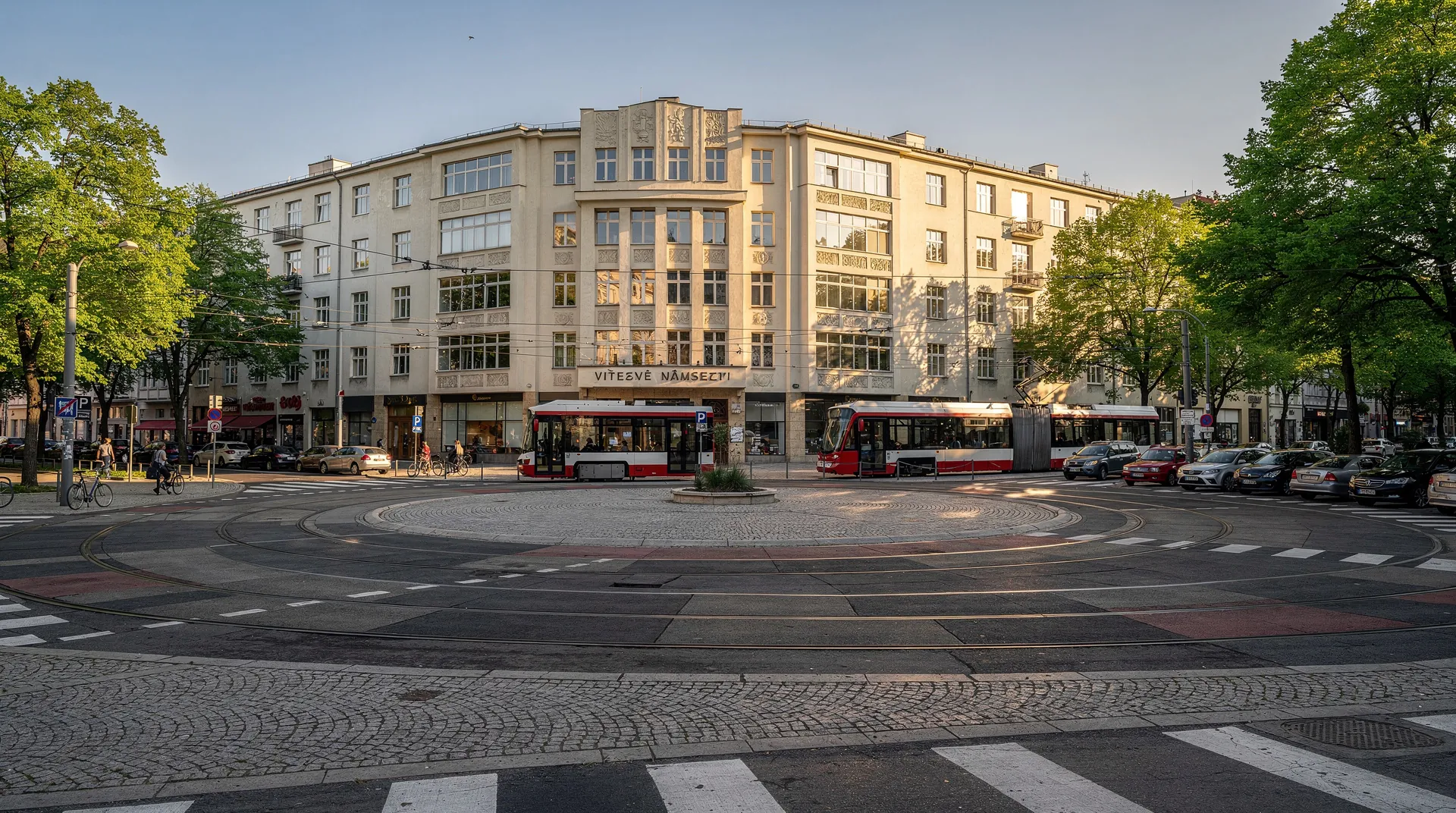
Food options: The kiosk at the entrance (near the tram terminus) sells drinks, grilled sausages, and basic snacks. The Džbán beach bar serves similar fare in season. There is nothing inside the reserve between these two points. For a proper meal, return to Dejvice: the streets around Vítězné náměstí have several good restaurants, and the Dejvice neighbourhood in general has a functional local-restaurant scene without the tourist markup of the centre.
What to avoid: The reserve is significantly busier on summer weekends from about 11:00 onward. If you want the valley to yourself, come on a weekday morning. The Džbán beach on a Saturday in late July resembles a city beach — noisy, crowded, exactly what some people want and others don’t.
Why locals love it (and tourists don’t find it)
Divoká Šárka does not appear in most tourist itineraries because it offers nothing that a tourist guide can sell easily: no panoramic tower, no medieval monument, no famous name in the guidebook sense. What it offers instead is 10 km² of actual nature inside a European capital, 25 minutes from the Old Town, with rocky canyon walls, a swimming reservoir, and paths that are almost entirely free of English-speaking visitors.
Prague residents know it well. On summer weekends the trams to Divoká Šárka carry families with beach bags, cyclists with helmets, runners, and retired couples with nordic walking poles — exactly the population that uses the reserve as a maintained piece of city nature rather than an attraction. The paths show it: they are well-worn, the benches are placed with knowledge of where the shade falls in the afternoon, and the connections between trails are intuitive in the way that locals’ knowledge builds over time.
The absence of tourist infrastructure is also an absence of tourist prices. The only paid access point in the reserve is the Džbán beach admission, and that is priced for a city beach, not a tourist attraction. Everything else — the trails, the meadows, the geological features, the views — is free and open continuously.
For visitors on a longer Prague trip who have already covered the standard itinerary, Divoká Šárka is the correct answer to the question of what to do on a quiet morning in this city. It is not spectacular in any single way. It is quietly excellent in every way that a city nature reserve can be.
Divoká Šárka vs Prague’s other green spaces
If you’re deciding between a green-space visit and Divoká Šárka, this comparison helps:
| Park | Feel | Distance from centre | Best for |
|---|---|---|---|
| Divoká Šárka | Wild nature reserve, canyon and stream | ~25 min by tram | Genuine hiking, swimming, near-zero tourists |
| Letná Park | Urban park with skyline views | 10–15 min walk from Old Town | Sunset views, beer garden, convenience |
| Petřín Hill | Landscaped hill, orchards, funicular | 10–15 min from Malá Strana | Panoramic views, a short tower climb |
| Stromovka | Flat royal park, ponds, avenues | 15–20 min tram from centre | Easy strolling, families, cycling |
Divoká Šárka is the only one of the four that feels genuinely rural rather than urban-park — the trade-off is the extra travel time.
Making the most of a half-day visit
The single best strategy for a first visit is the loop described above: yellow trail out through the valley, green trail back along the ridge, roughly 7–8 km and 2–2.5 hours including a stop at Džbán. If you’re short on time, skip the ridge climb and simply walk the yellow trail as far as Čertův mlýn and back — about 45 minutes round trip, flat, and it still covers the most atmospheric section of the canyon.
Combine it, if you like, with time in Dejvice itself — the neighbourhood around Vítězné náměstí has a genuine local restaurant scene, useful for a proper meal before or after the reserve, since food options inside Divoká Šárka are limited to two seasonal kiosks.
Frequently asked questions about Divoká Šárka
Is Divoká Šárka free to visit?
The nature reserve itself is entirely free and open 24 hours a day, all year. The Džbán reservoir beach charges a small admission fee in peak season (approximately May–September), currently around 100 CZK per adult (roughly €4). Outside managed beach hours and in the off-season, the reservoir area is freely accessible.
Can you swim in Divoká Šárka?
Yes, at the Džbán reservoir. The beach is managed from approximately late May to early September, with facilities (changing rooms, toilets, a refreshment stand). Water quality is monitored by the city throughout the season. Swimming outside the managed season is possible but without lifeguard presence.
How long does it take to walk through the reserve?
Walking the valley floor on the yellow trail from the tram terminus at the eastern entrance to the far western end of the reserve takes roughly 45–60 minutes at a comfortable pace. A loop combining the valley floor and the northern ridge trail (green trail) is approximately 7–8 km and takes 2–2.5 hours.
How do I get to Divoká Šárka by public transport?
Trams 20 and 26 terminate at Divoká Šárka. From Dejvická metro station (Line A, end of the green line), tram 20 or 26 reaches the reserve in about 10 minutes. The full journey from the city centre (Náměstí Republiky area) takes approximately 25 minutes. Any valid DPP Prague public transport ticket is required — the standard 30-minute ticket (32 CZK) is sufficient from nearby stops.
Is Divoká Šárka good for children?
Yes. The valley floor trails are easy, the Džbán beach has a shallow entry point and a grassy area for children, and the terrain is varied enough to hold attention. The yellow trail along the stream is manageable for children aged 4 and above. Bring sunscreen for the open meadow sections in summer.
Are dogs allowed in Divoká Šárka?
Dogs are allowed in the reserve. Keep them on a lead in the areas signed as protected zones (the core nature reserve sections); off-lead areas exist on the upper grassland sections. Dogs are not permitted on the managed beach area at Džbán during the swimming season.
Is there parking at Divoká Šárka?
There is a small car park near the tram terminus. It fills quickly on summer weekends, often by 10:00. Street parking on Evropská (the main road above the valley) is an alternative, with a short walk down to the reserve entrance. Public transport is the more practical approach on weekends.
How does Divoká Šárka compare to Letná or Petřín for a quick nature fix?
If you only have a spare hour and are already in the centre, Letná Park or Petřín Hill are more convenient — both are a short walk from Old Town or Malá Strana. Divoká Šárka takes longer to reach but delivers a genuinely different, wilder experience that neither of the closer parks can match.
Is Divoká Šárka safe to visit alone?
Yes. It’s a well-used, well-maintained municipal reserve with clear trails and regular local foot traffic, especially on weekends. As with any wooded area, stick to marked trails after dark and let someone know your general plan if hiking the full loop alone on a quiet weekday.
Practical info at a glance
- Address: Evropská / Divoká Šárka, 160 00 Praha 6 — Vokovice
- Reserve opening hours: Always open, 24/7, all year
- Džbán beach: Open approximately May–September, 10:00–19:00; admission ~100 CZK / €4 in peak season
- Nearest tram: Tram 20 or 26 to “Divoká Šárka” terminus (final stop)
- Nearest metro: Dejvická (Line A, green) — then tram 20 or 26, approx. 10 minutes
- Reserve admission: Free
- Food at the reserve: Kiosk at the tram terminus (seasonal); Džbán beach bar (May–September)
- Official information: Prague 6 municipal website / nature reserve management