Why Lucerna Palace is the best 5-minute detour from Wenceslas Square
Palác Lucerna is 50 metres from Wenceslas Square. It is free to enter and takes 5 minutes to walk through. It contains one of Prague’s most photographed sculptures, the oldest cinema in the city, and one of the better Art Nouveau interiors in Nové Město. The question is not whether to visit — it’s whether you know it exists.
Most visitors walk past it, partly because the entrance from Wenceslas Square is unassuming (a door between shops), partly because the arcades of central Prague are collectively underappreciated as interior architecture. Lucerna rewards the small amount of effort required to find its entrance.
It’s worth five minutes if you’re near Wenceslas Square. It’s worth twenty if you want to see the Černý sculpture, buy a coffee, and explore the Art Nouveau staircase and the old cinema lobby.
| At a glance | |
|---|---|
| Where | Vodičkova 36 / Štěpánská 61, Nové Město, ~50 m off Wenceslas Square |
| Cost | Free (arcade and sculpture); cinema around €7–9 / 175–225 CZK per screening |
| Time needed | Around 5–20 minutes |
| Getting there | Metro Můstek (Lines A/B), 3 min walk |
| Best time | Any time during opening hours; early morning for photos without crowds |
The story of Palác Lucerna
Lucerna Palace was the project of Václav Maria Havel — grandfather of Václav Havel, the playwright who became the first post-communist president of Czechoslovakia. The elder Havel built the palace beginning in 1907, combining a large entertainment complex — cinema, theatre, concert hall, ballrooms, café, shops — under a single roof in a then-new arcade format that was fashionable in Paris and Vienna.
The name “Lucerna” (lantern) referenced the electric light displays that were novel in 1907 and that the building was designed to show off. The use of electric lighting throughout an interior space was a demonstration of modernity at the time of opening.
The project was ambitious: the Lucerna Grande Hall became one of the main Prague entertainment venues of the early 20th century — concerts, balls, political rallies, film screenings, and theatrical performances all took place here. The Lucerna film theatre (Kino Lucerna) opened in 1909, making it one of the oldest continuously operating cinemas in Europe.
The Havel family retained ownership through the First Republic (1918–1938). The communist government nationalised the building in 1948. After 1989, Václav Havel the playwright and president initiated a legal process to reclaim the family property; the building was eventually returned to the Havel family under restitution law and remains in their ownership today.
What to see in Lucerna Palace
The arcade and atrium
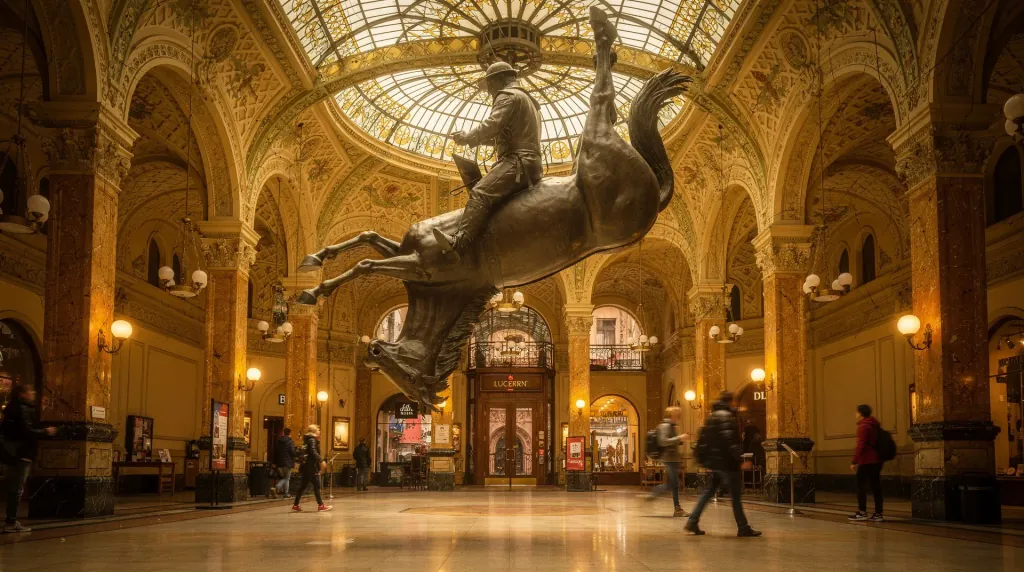
The main arcade runs between Vodičkova and Štěpánská streets, passing through a glass-roofed atrium that rises several floors. The Art Nouveau ironwork, the coffered glass ceiling, and the shop fronts from various periods of 20th-century renovation give the space a layered quality — not as pristine as the Municipal House arcade, more lived-in.
From the atrium, stairs and galleries lead to the upper floors with the concert hall entrance and café.
David Černý’s Wenceslas sculpture (Koně)
The most visited object in the arcade is a sculpture by David Černý, installed in 1999 as a commentary on the St Václav (Wenceslas) equestrian statue at the top of Wenceslas Square. The original statue shows the patron saint of Bohemia on a living horse in heroic posture. Černý’s version — hanging from the ceiling of the Lucerna atrium — shows Wenceslas on a dead horse, riding upside down, with the horse dangling belly-up and the rider maintaining his composed expression. The title of the work is simply “Koně” (Horse).
The piece has been interpreted as a comment on Czech national mythology, on the relationship between heroic statues and political reality, or simply as a provocation. Černý himself has been ambiguous about the intended meaning — characteristic of his approach to public art. The sculpture hangs at approximately 5 metres above the floor, visible from the atrium entrance.
Kino Lucerna
The Lucerna cinema, entered from the arcade, is the oldest continuously operating cinema in the Czech Republic, having opened in 1909. The current screening room retains elements of the original interiors, including Art Nouveau decorative details in the lobby. The programme mixes repertory screenings, retrospectives, and special events — it is not a mainstream first-run cinema. Check the current programme at kinoprague.com.
The Grande Hall and concert spaces
The Lucerna Grande Hall — a large ballroom and concert space on the upper floors — hosts concerts, events, and occasional club nights. It is not generally open for sightseeing but is accessible when events are scheduled. The programme ranges from jazz and classical concerts to private corporate events.
The café
A café on the ground floor of the atrium serves standard coffee, pastries, and light food. Useful for a rest near Wenceslas Square; the setting in the Art Nouveau arcade is preferable to most café options on the square itself.
Tickets and access
The arcade, atrium, and Černý sculpture are entirely free to access during opening hours (approximately 09:00–22:00 daily). The cinema charges standard ticket prices per screening (approximately €7–9 / 175–225 CZK). The concert hall and event spaces are ticketed per event.
Which tour to book nearby
For a Prague Art Nouveau tour that provides context for Lucerna’s architectural heritage:
Prague Art Nouveau walking tourFor a private Cubism and Art Nouveau tour combining Lucerna with Municipal House and other key buildings:
Prague private Cubism and Art Nouveau walking tourFor a top sights tour that covers the historic centre including Nové Město and Wenceslas Square:
Prague top sights and historic centre introduction tourFor a small-group e-bike tour covering Nové Město and the surrounding districts:
Prague small group e-bike city tourHow to get there
Metro: Můstek (Lines A and B) or Muzeum (Lines A and C) — both within 5 minutes’ walk. Lucerna is mid-Wenceslas Square on the right side (coming from Můstek), entered via Vodičkova or Štěpánská.
Tram: Multiple lines stop on Vodičkova or at the top of Wenceslas Square.
On foot from Old Town Square: Walk south through Můstek junction onto Wenceslas Square. Lucerna is on the right, roughly midway along the square, set back behind the street-level shops.
Photographer’s note
The Černý horse sculpture is photographed from below, looking up, with the full atrium height visible in frame. Use a wide-angle lens — a 16–20mm equivalent — to capture the horse from below and include the glass ceiling above. Natural light filters through the glass roof in the middle of the day, but the sculpture hangs in partial shadow; a slight underexposure makes the dark horse figure stand against the lighter background.
The arcade itself photographs well at the junction of Vodičkova and Štěpánská, looking into the glass-roofed interior from the street entrance. Early morning (before shops open) gives the cleanest shot without people in frame.
The Havel family connection: three generations of Prague
The Lucerna Palace’s ownership history is inseparable from one of Czech culture’s most complicated dynasties. Václav Maria Havel built the palace in 1907; his son Miloš Havel (1899–1968) developed it into one of Prague’s leading cinema and entertainment venues during the First Republic; his grandson Václav Havel (1936–2011) was the playwright, dissident, and first post-communist president.
The communist nationalisation in 1948 removed the building from the family. Miloš Havel, who had been the dominant personality in Czech film distribution and cinema management during the 1930s and 1940s, emigrated to West Germany in 1952. The family’s business empire — Lucerna, a film distribution company, several other properties — remained nationalised.
Václav Havel the playwright grew up in a family whose property had been confiscated, in a city where that family’s contributions to cultural life were officially minimised. The autobiographical weight of this in his theatrical work — the absurdist plays about bureaucracy, the individual under the system, the loss of private space — has been analysed extensively. The Lucerna connection gave him a specific relationship to the communist state’s dispossession that was more concrete than the general intellectual’s experience of censorship.
After 1989, the restitution of Lucerna to the Havel family was legally complicated — the palace had been modified, its various operating companies had complex histories, and the real estate law governing restitution was still being written. The building is now held by Lucerna Real Estate, controlled by the Havel family heirs. Václav Havel himself took little direct interest in the business aspects of the inheritance; his literary estate is managed separately.
Wenceslas Square and its political history: context for the Černý sculpture
David Černý’s upside-down horse makes most sense in the context of Wenceslas Square’s political biography.
The original equestrian statue of St Václav (Wenceslas) at the top of the square was designed by Josef Václav Myslbek and unveiled in 1912 — a work in progress since 1887. The statue shows Wenceslas in heroic posture on a living horse, surrounded by four other patron saints of Bohemia. It anchors the political geography of the square: major political events have been announced, celebrated, or mourned here, with the Wenceslas statue as the fixed point.
On 28 October 1918, independence was proclaimed from the top of the square. In March 1939, Nazi troops marched through it. In August 1968, Soviet tanks arrived here. On 16 January 1969, Jan Palach set himself on fire in front of the National Museum at the top of the square in protest against the Soviet occupation — becoming one of the most significant martyrdom events in Czech history. In November 1989, the Velvet Revolution played out primarily here.
The statue has been the site of wreath-laying, protest, celebration, and trauma. Černý’s inversion — the dead horse, the still-composed rider — is a comment on the gap between the monument’s heroic programme and the square’s traumatic history. Or it is a comment on Czech national mythology and its tendency to project dignity onto catastrophe. Or it is simply funny, if you’re in that frame of mind.
All three readings are available simultaneously. This ambiguity is characteristic of Černý’s best work.
Kino Lucerna and the history of cinema in Prague
Prague has a rich cinema history that intersects with wider Czech cultural production. Kino Lucerna (1909) was not the first cinema in Prague — the first film screenings in the city were at the Ponrepo cinema in 1907 — but it was the first purpose-built cinema with a dedicated permanent theatre.
Czech cinema developed into a significant international form in the 1960s with the Czech New Wave: Miloš Forman (Loves of a Blonde, The Fireman’s Ball), Jiří Menzel (Closely Watched Trains), Věra Chytilová (Daisies), and others. These films were produced at the Barrandov Studios (the largest film studios in Central Europe, in the Braník district of Prague) and distributed internationally in the 1960s before the Soviet-era normalisation shuttered most of the significant filmmakers.
Kino Lucerna today runs a programme of repertory screenings, retrospectives of Czech and international cinema, and themed festivals. It is not a mainstream first-run cinema — you won’t see current blockbusters here — but for anyone interested in film history, a screening at the oldest operating cinema in the Czech Republic has a specific texture.
The projector is digital (the original Lucerna projector operated until the late 1990s; no 35mm cinema in Prague has maintained analogue projection commercially since around 2015), but the architecture of the screening room — the Art Nouveau lobby, the original ceiling details — is intact.
Practical note: the other Prague arcades
Lucerna is one of several historic arcades in the Nové Město district that are worth walking through. In order of interest:
Palác Lucerna (Vodičkova 36): The most architecturally interesting, with the Černý sculpture and the old cinema.
Palác Alfa (Václavské náměstí 28): A 1920s modernist arcade on Wenceslas Square, more austere in style. Good for a through-route without tourist stops.
Palác Koruna (Václavské náměstí 1 / Na Příkopě): Interwar Czech modernist, with a cupola visible from the street. Currently a shopping centre.
A 30-minute walk threading through these arcades gives a sense of how urban Prague commerce operated in the early 20th century, before the individual shopfronts and malls of the post-communist period dominated the ground floors.
Frequently asked questions about Lucerna Palace
Is Lucerna Palace free to visit?
The arcade and the Černý sculpture are free. The cinema is ticketed per screening (approximately €7–9 / 175–225 CZK). Concert and event tickets vary.
What is David Černý’s horse sculpture in Lucerna?
A 1999 work by Czech artist David Černý showing Wenceslas — the patron saint of Bohemia, featured in the famous equestrian statue at the top of Wenceslas Square — riding an upside-down dead horse, suspended from the atrium ceiling. It is one of Černý’s best-known works in Prague.
Is the Lucerna cinema still operating?
Yes — Kino Lucerna has been operating since 1909 and is the oldest continuously operating cinema in the Czech Republic. It shows repertory and special programme screenings. Not a mainstream multiplex.
Who built Lucerna Palace?
Václav Maria Havel, grandfather of Václav Havel (the writer and future president). The palace was built from 1907 and represents one of the first major mixed-use entertainment complexes in Central Europe.
Is Lucerna Palace close to Wenceslas Square?
It opens onto Wenceslas Square — the arcade entrance is set back slightly from the main pavement but is accessible directly from the square. Approximately 50 metres from the square’s main pedestrian axis.
Can you visit the Grande Hall without attending an event?
Generally no — the Grande Hall and upper concert spaces are accessible only when events are scheduled. The atrium, arcade, and cinema lobby are accessible during normal hours.
Is Lucerna Palace worth visiting if I only have one day in Prague?
Yes, if your one day includes Wenceslas Square — it costs nothing extra in time or money and adds a genuinely memorable stop (the Černý sculpture) to an itinerary that might otherwise treat the square as just a walk-through corridor.
Wenceslas Square in brief: why it’s important and how to walk it
Since Lucerna is on Wenceslas Square, a brief guide to the square itself is useful context.
Václavské náměstí is not a square in the traditional sense — it is a 750-metre boulevard, 60 metres wide, running north–south from Můstek (at the Old Town edge) to the National Museum at the top. It functions simultaneously as a commercial street, a transit corridor (trams, buses, pedestrian), and the city’s primary political space.
The St Václav equestrian statue at the upper end has been the focal point for major historical events: the 1918 declaration of independence was celebrated here; in March 1939 Nazi troops marched down the square; in August 1968 Soviet tanks were photographed at the top; in November 1989 the Velvet Revolution took place primarily here. The square’s geometry — the statue at the top, the museum behind it, the long commercial axis leading to the Old Town — makes it a natural gathering point.
Walking from Můstek to the museum takes approximately 10 minutes without stopping. The lower section (Můstek to Jindřišská street) retains the most architectural coherence, with several intact Art Nouveau and early modernist facades on the upper floors. Lucerna is on the right (west) side of the square approximately midway along.
The upper section (above Jindřišská) is more mixed, with post-communist commercial development. The National Museum at the top is a Neo-Renaissance building comparable in scale and idiom to the Rudolfinum; its permanent collections include natural history and history exhibitions.
Practical info at a glance
- Address: Štěpánská 61 / Vodičkova 36, 110 00 Praha 1
- Opening hours: Arcade daily approx. 09:00–22:00 (free); cinema by screening schedule
- Price: Free (arcade); cinema ~€7–9 / 175–225 CZK per screening
- Nearest metro: Můstek (Lines A and B) — 3 min walk
- Website: lucerna.cz / kinoprague.com (cinema)