Národní třída, 08:47 on November 17
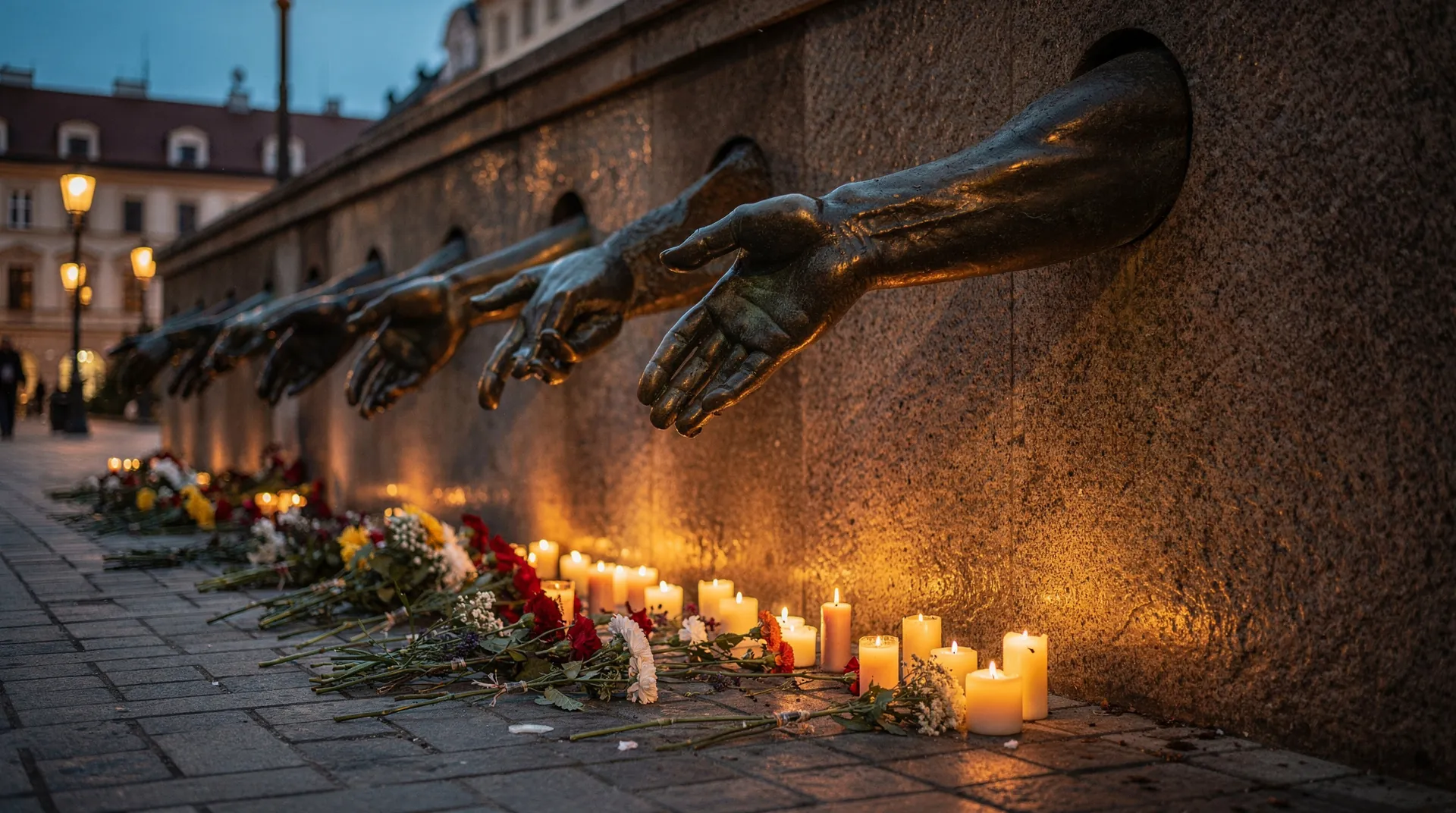
There are candles already when we arrive at the plaque. It is not yet 9:00 in the morning. Someone — we don’t know who, someone who got here before us — has placed a small bunch of red carnations below the bronze hands reaching upward. The flowers are fresh. The candles are tea lights in glass holders, the kind you buy at a supermarket. There is a handwritten card in Czech that we can partially read: “Na jejich počest” — in their honour.
The anniversary is a Tuesday this year. People will pass this spot going to work. Most of them know what the plaque commemorates. Some will stop for a moment. Some will not. Both are correct responses to a memorial that is thirty-five years old — old enough to have moved from living memory into history for anyone under forty, old enough that its meaning has to be actively transmitted rather than automatically felt.
We stand here for ten minutes, which is more than most people do, and less than the occasion deserves.
November 17, 1989 — and what actually happened
On November 17, 1989, a student march in Prague commemorating the 50th anniversary of the Nazi closing of Czech universities turned into the beginning of the end of Communist rule in Czechoslovakia. Police blocked the march on Národní třída and beat the students. The violence was witnessed and reported. Within days, hundreds of thousands of people were gathering on Wenceslas Square, jingling their keys at the Communist government in a gesture that said, simply: time is up.
Václav Havel, a playwright who had spent the previous two decades writing samizdat documents and serving prison sentences for his dissent, became president by the end of December. The entire transition — from street violence on November 17 to a non-Communist government in December — took 41 days. It was, by the standards of political revolution, extraordinarily peaceful and fast. The name “Velvet Revolution” (Sametová revoluce) was coined to describe precisely this character.
On November 17, 2024, it was 35 years. We walked the sites.
| At a glance | |
|---|---|
| Where | Národní třída plaque, Wenceslas Square, Letná Plain — all free, self-guided |
| Cost | free for the sites; Museum of Communism around €15 / 375 CZK |
| Time needed | around 2–3 hours for all three sites plus the museum |
| Best time | November 17 itself for atmosphere (crowds, candles from around 17:00), otherwise any time of year |
| Getting there | all sites reachable on foot or by metro from central Prague |
Národní třída — where it started
The most important physical site of the Velvet Revolution is not Wenceslas Square, though that is where the crowds gathered. It is a stretch of Národní třída — National Street — between Spálená and the river, where the police cordon on the evening of November 17 stopped the marchers and where the beatings occurred.
Today, a bronze plaque on the wall of a building on Národní třída marks the spot. Hands reaching upward — the memorial was installed in 1989 and has become a site of regular commemoration. On November 17, the plaque is covered in candles, flowers, and photographs of people who were beaten. It is one of the more moving sites in Prague — small, unobtrusive, easy to walk past without noticing unless you’re looking.
On the anniversary this year, perhaps 200 people stood at the plaque at mid-morning, many in silence, some reading the inscriptions. The mood was not festive. The 35 years have produced a Czech Republic with complicated feelings about the revolution’s outcomes — economic growth, EU membership, genuine democracy on one hand; post-communist disillusionment, oligarchic politics, a sense among some that the revolution’s ideals were imperfectly realised on the other.
Wenceslas Square — the geography of the crowd
Wenceslas Square (Václavské náměstí) is not a square. It is a long urban boulevard — 750 metres from the National Museum at the upper end to Můstek at the lower end, 60 metres wide, lined with shops, hotels, and restaurants. In November 1989, an estimated 300,000–500,000 people filled it, more than had ever assembled in a Czech public space.
Standing at the upper end, in front of the equestrian statue of St. Václav (Wenceslas), and looking down the length of the square, you can imagine this. The square can hold the crowd; the statue gives it a focal point; the National Museum behind you closes the visual theatre. Havel and Alexander Dubček (the reform Communist leader of the 1968 Prague Spring, rehabilitated by the revolution) appeared on the balcony of the Melantrich bookshop building (now a Marks and Spencer, which is the kind of irony the 21st century specialises in) and addressed the assembled crowds.
The balcony is still there, unmarked. The building is still there. The square is otherwise full of H&M stores and McDonald’s, which represents either capitalism’s triumph or capitalism’s vulgarity, depending on how you’re inclined on a given day.
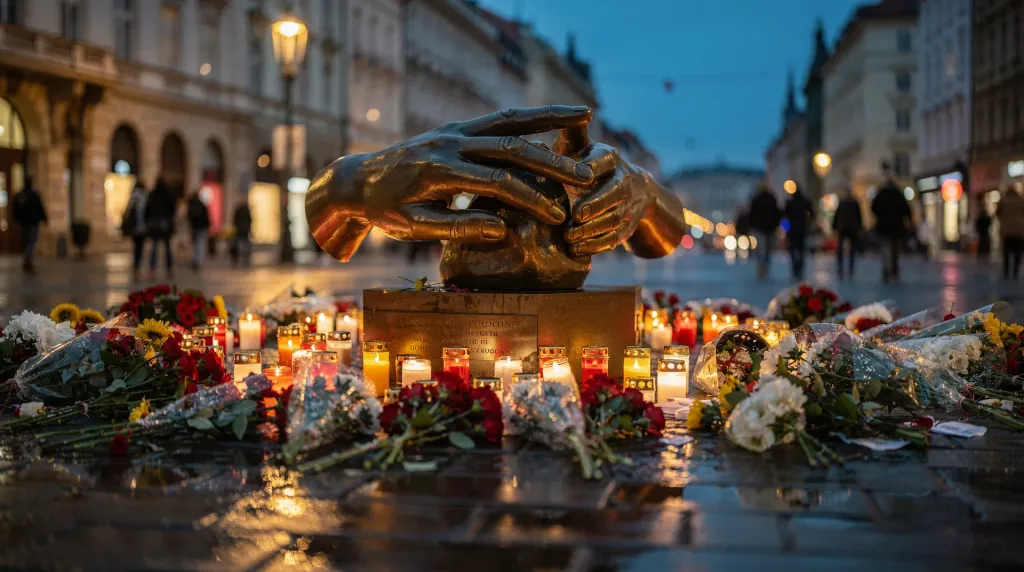
There is a permanent Velvet Revolution memorial near the Václav statue: a small sculptural group of figures, with quotations from Havel’s speeches on a nearby panel. Not overwhelming, but contextual.
Letná Plain — the 750,000 person crowd
On November 25 and 26, 1989, the largest public gathering in Czech history took place on Letná Plain — the flat promontory above Holešovice and the Vltava, where a vast gigantic Stalin statue had stood until 1962. An estimated 750,000 people came on November 25 to hear Havel and Dubček speak, and to hear the sound of their own voices doing something that had been impossible for 40 years.
Walking Letná Plain today — where Prague residents jog, walk dogs, drink beer in the summer garden, fly kites — the scale of what that gathering means is hard to hold. There is no monument to it. There is a large metronome (installed in 1991, replacing the Stalin statue base). There is the beer garden. There are the views over the city. If you want to linger, the Letná Park guide covers the panorama, the beer garden, and the metronome.
The absence of a memorial at Letná is, in its own way, characteristic of how Czechs process their history — with irony and understatement rather than monument-building. The metronome, which was installed more or less as a conceptual art joke and has since become a genuine Prague landmark, is perhaps the most appropriate marker of a revolution that was itself improbable, fast, and somewhat miraculous.
The Museum of Communism (Muzeum komunismu)
A useful complement to the site walk is the Museum of Communism, located just off Wenceslas Square. It covers the full arc of Communist rule in Czechoslovakia from 1948 to 1989, with objects, photographs, and explanatory text that contextualises what the revolution was overthrowing: the show trials of the 1950s, normalisation after 1968, the Charter 77 human rights declaration, and the economics and daily life of the Communist period.
Entry is around €15 / 375 CZK. Allow 1.5–2 hours.
Museum of Communism entrance ticket — pre-purchase to skip the ticket queue.
What the 35 years feel like in 2024
The Czech Republic in 2024 has had a complicated relationship with the post-revolutionary settlement. The euphoria of 1989 was followed by the economic shock therapy of the early 1990s, the peaceful dissolution of Czechoslovakia in 1993 (the Velvet Divorce — the Slovak Republic became independent), and a political evolution that has produced both EU membership in 2004 and a persistent strand of populism and oligarchic politics in the 2010s.
Havel, who died in 2011, has become a figure of almost universal Czech retrospective admiration — which is interesting because his actual presidency (1993–2003) was marked by considerable political controversy. The revolution he symbolised has acquired the quality of a founding myth, which is appropriate, but also simplifying.
What we saw on November 17 at Národní třída — the 200 quiet people, the candles, the photographs — felt like a society still processing what it had done. Still deciding what it meant.
Putting the walk in the wider Prague picture
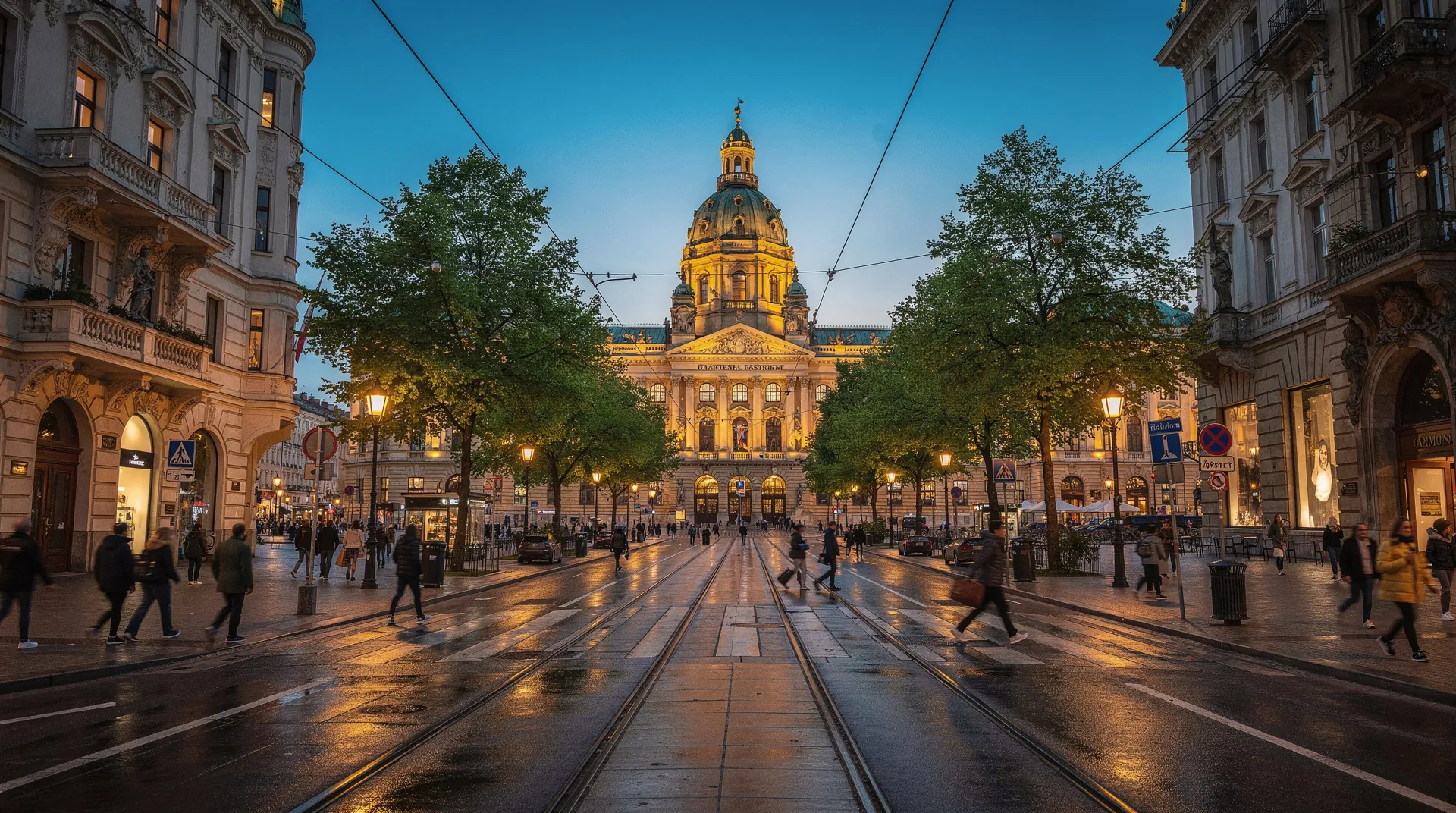
The Velvet Revolution sites make more sense alongside the city’s broader 20th-century story. If you’re building a themed day around modern Czech history, the communist-era Prague theme links the revolution sites to the wider Communist-period architecture and neighbourhoods, including parts of Žižkov and Vítkov that carry their own layered history. If your schedule is tight, the 1-day Prague itinerary shows where a Velvet Revolution walk can slot in alongside the Old Town highlights without overloading the day. Those highlights start at Old Town Square, a short walk from the lower end of Wenceslas Square.
The Communism tour — a complement to the site walk
The physical sites of the Velvet Revolution are free to visit and self-guided. But the political and social context — the show trials of the 1950s, the mechanics of normalisation after 1968, the way the Communist system shaped daily life in ways that are not visible from a plaque on a wall — requires more than standing in front of monuments.
The Prague Communism and Nuclear Bunker Tour covers the Communist period through actual infrastructure: the underground Cold War bunker built beneath central Prague, propaganda material, and a guide who grew up under the system and can speak to it personally. Approximately €72 / 1,800 CZK. The bunker component alone — an enormous concrete structure that most Praguers have never entered — justifies the cost.
Reader questions
“I’m visiting in November — will there be anniversary events?”
November 17 is a Czech national holiday (Den boje za svobodu a demokracii — Day of the Struggle for Freedom and Democracy). The main commemoration is at the Národní třída plaque at approximately 17:00 (5pm), where thousands of people gather with candles. Václavské náměstí has separate events including speeches and concerts. In recent years, the 17 November events have also drawn counter-demonstrations from political groups who dispute the revolution’s legacy — this is a sign of a functioning democracy, not a disruption to avoid.
If you are not in Prague on November 17, the Národní třída plaque and Wenceslas Square sites are worth visiting any time of year. The meaning does not diminish with the date.
“What’s the most honest account of what the revolution meant for Czech society?”
The Museum of Communism (Muzeum komunismu) is the most direct and honest institutional account available to visitors in English. Allow 1.5–2 hours. The more complicated question — what the post-revolutionary settlement actually produced — is addressed in the museum’s final section and is worth sitting with. The Czech relationship to its own 1989 is considerably more ambivalent than Western European coverage of the event suggests.
“Can I do the site walk on my own without a guide, or is a tour worth it?”
The three main sites — Národní třída, Wenceslas Square, Letná Plain — are free, well-signed enough with context from articles like this one, and easily walkable in a single afternoon on your own. A guided tour earns its cost mainly for the underground bunker component and for a guide’s personal memory of the period, not for the outdoor sites themselves.
A note on the 2024 anniversary
The 35th anniversary in November 2024 was notable for both the size of the commemorations — the largest November 17 gatherings in a decade, which some analysts attributed to the political mood in the Czech Republic — and for the number of people under 30 who attended events they had learned about in school rather than through personal memory. The handoff from lived memory to institutional history is, in 2024, clearly underway.
What we saw at Národní třída that morning was the result of people who came before 9:00, without any external organisation, because it felt like the right thing to do. That habit — the Czech habit of honouring the things that cost people something — has not yet been bureaucratised out of existence.
Related reading
The Velvet Revolution walking guide covers the Národní třída memorial, Wenceslas Square Havel sites, and the Letná Plain in a single self-guided walk. The Wenceslas Square guide places the square in its full historical context.